The Real Test for Autonomous Mobility Is Not the Vehicle. It Is the Operating Ecosystem.

Updated: Sep 19
Autonomous vehicles are usually discussed as a technology story.
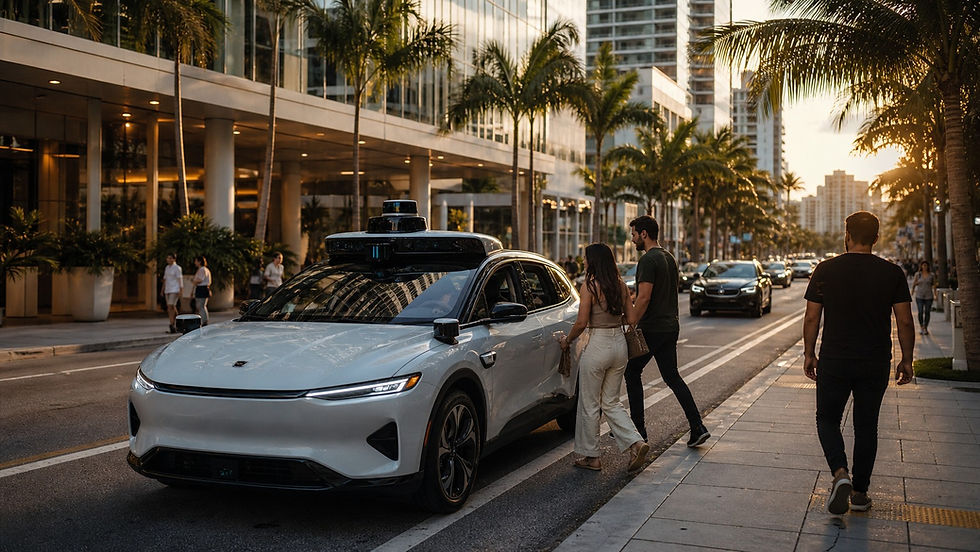
That makes sense. The technology is impressive. A car moving through Miami traffic without a human driver is not a small thing. It is the kind of product experience that still feels slightly unreal, even after years of hearing that self-driving transportation was coming.
But the more interesting question is not whether the vehicle can drive.
The harder question is whether the company behind it can earn enough trust, in enough places, with enough stakeholders, to make autonomous mobility feel normal.
That is where the real operating challenge begins.
Waymo’s expansion in Miami is a useful example because Miami is not a quiet test market. It is dense, international, weather-exposed, tourism-heavy, and operationally messy in all the ways real cities are messy. You have local residents, airport traffic, tourists, commuters, hospitality workers, city officials, emergency services, insurers, fleet partners, maintenance partners, charging infrastructure, accessibility groups, and riders trying the product for the first time.
The vehicle matters. But the ecosystem around the vehicle may matter just as much.
Market entry is not the same as product launch
In software, teams often talk about launching into a market as if the main challenge is awareness. Make the product available. Create demand. Remove friction. Scale usage.
That model is incomplete for autonomous mobility.
A robotaxi service does not enter a market like a SaaS app enters a new segment. It enters public space. It interacts with streets, weather, public safety, rider behavior, local expectations, and existing transportation networks. It has to work not only in ideal conditions, but in the awkward moments: a blocked lane, a confused pedestrian, a sudden storm, a concert letting out, a school zone, a construction detour, a police officer giving hand signals, or an airport pickup with a rider who has never used the service before.
This is why the expansion playbook matters.
The company that wins will not be the one with the best demo. It will be the one that builds the most repeatable way to enter new cities without losing operational quality.
That requires more than engineering. It requires local trust architecture.
The competitive landscape is really an execution landscape
Waymo is clearly one of the leaders in the U.S. robotaxi market. It has real commercial service, public deployments, and a growing operational footprint. Amazon-backed Zoox is pursuing a different model with a purpose-built autonomous vehicle, while Tesla continues to pursue autonomy through a very different hardware and software strategy. Cruise, once one of the most visible players, became a reminder that technical ambition is not enough when safety, regulation, public trust, and economics start to collide.
That tells us something important.
The autonomous vehicle market is not just a race between algorithms. It is a race between operating models.
Different companies are making different bets. Some are betting on purpose-built vehicles. Some are betting on consumer vehicle scale. Some are betting on tightly controlled service areas and gradual expansion. Some are betting on partnerships with ride-hailing platforms, fleet operators, manufacturers, or local infrastructure players.
The strategic question is not simply, “Who has the best self-driving technology?”
It is also:
Who can build the best partner network?
Who can manage city-by-city complexity?
Who can respond to local concerns without slowing down every expansion?
Who can create a consistent rider experience while adapting to local conditions?
Who can make regulators, emergency services, fleet partners, and riders feel that the system is improving, not just growing?
That is an ecosystem question.
Trust has to be operational, not just emotional
Trust is often described as a brand outcome. People trust a company because they like it, recognize it, or believe its claims.
In complex systems, trust works differently.
Trust is built when the system behaves predictably, when issues are handled quickly, when stakeholders know who to call, when partners understand their role, and when small problems do not become public failures because nobody owned the handoff.
For autonomous mobility, trust has several layers.
There is rider trust: Will the vehicle arrive? Will the ride feel safe? Will the app explain what is happening clearly enough?
There is city trust: Will the company coordinate with public agencies, respond to incidents, and adapt to local rules?
There is partner trust: Will fleet, charging, maintenance, mapping, operations, and support partners have clear standards and escalation paths?
There is internal trust: Will product, operations, policy, legal, support, business development, and local market teams make decisions from the same operating picture?
This is where many ambitious companies struggle. They invest heavily in the product but underbuild the operating cadence around it.
The result is usually not one dramatic failure. It is drift. Slow response times. Unclear ownership. Inconsistent partner expectations. Local concerns that surface too late. Teams that are technically aligned but operationally disconnected.
In a market like autonomous mobility, that is dangerous. The gap between technical deployment and public acceptance can become the whole business.
Partnerships become part of the product experience
In many industries, partnerships sit outside the product. They help with distribution, implementation, referrals, integrations, or customer support.
In autonomous mobility, partnerships are much closer to the core experience.
A rider may never know which partner supports fleet operations, charging, maintenance, airport coordination, insurance, local market logistics, or emergency response training. But the rider feels the quality of those partnerships anyway.
If the vehicle is clean, charged, available, routed correctly, and supported when something unusual happens, the ecosystem is working.
If not, the rider may blame the brand, even when the failure sits somewhere inside the operating network.
That is why partner management in a market like this cannot be treated as a relationship layer only. It has to be a performance system.
Strong partnership teams need clear expectations, shared metrics, escalation paths, feedback loops, and a way to distinguish between normal operating friction and patterns that need intervention. They need enough structure to scale, but not so much structure that local teams cannot respond to real conditions.
This is the same principle that applies in SaaS partner ecosystems, although the stakes and surface area are different.
A partner ecosystem is not strong because it has many participants. It is strong when the participants understand how value is created, where responsibility sits, and how decisions get made when the situation is unclear.
AI can compress analysis, but it does not replace judgment
Autonomous mobility is one of the clearest examples of AI moving from software into the physical world.
That makes the operational layer even more important.
AI can detect patterns, improve routing, support simulations, flag anomalies, and help teams learn faster from huge volumes of data. It can help identify local edge cases and prioritize where intervention is needed. It can also make partner operations more intelligent by surfacing trends across incidents, rider feedback, service availability, fleet performance, and market-level demand.
But AI does not remove the need for human judgment.
Someone still has to decide which problems matter most. Someone has to translate data into operational change. Someone has to work with external partners when the numbers suggest one thing and local context suggests another. Someone has to know when a partner issue is a training problem, a process problem, a commercial problem, or a trust problem.
The best use of AI in partner ecosystems is not to automate the relationship away.
It is to make the operating picture clearer so leaders can act earlier and better.
The real playbook on autonomous mobility is city-by-city trust at scale
Waymo’s Miami expansion is interesting because it is visible. People can see the cars. They can take the ride. They can debate whether they like the experience.
But behind the visible product is the more important question: can autonomous mobility become repeatable across markets without becoming generic?
Every city has different traffic behavior, different political expectations, different infrastructure, different weather, different rider patterns, and different public concerns. A company expanding across cities needs a model that is consistent enough to scale and flexible enough to localize.
That balance is hard.
Too much standardization, and the company misses local nuance.
Too much localization, and the operating model becomes expensive, inconsistent, and hard to govern.
The strongest expansion teams usually solve this through cadence. They define what must be consistent, what can adapt, who owns which decision, and how learning from one market improves the next. They do not rely on heroic execution every time. They build repeatable systems.
For autonomous mobility, that may become one of the defining advantages.
Not just better vehicles.
Better operating rhythm.
Better partner systems.
Better local trust-building.
Better escalation.
Better learning loops.
Better judgment about when to move fast and when to slow down.
The companies that scale trust will shape the category
Autonomous vehicles will keep improving. The technical progress is real, and the public will get more familiar with the experience as availability expands.
But the category will not be shaped by technology alone.
It will be shaped by the companies that can make the technology work inside real communities. That means building strong partnerships, listening to local stakeholders, coordinating across internal teams, and treating trust as an operating discipline rather than a marketing message.
Miami is a good test because it forces the issue. The city is dynamic, complex, and highly visible. If autonomous mobility can work there at meaningful scale, it will not be because the vehicle is impressive in isolation.
It will be because the system around the vehicle works.
That is the bigger lesson for any company trying to scale a new category.
The product may get you into the market.
The ecosystem determines whether you stay there.
Inspiring Sources
Waymo Florida announcement
Anchor text: Waymo’s expansion in Miami and Orlando
Reuters market expansion / competitive context
Anchor text: Waymo’s broader U.S. robotaxi expansion
Car and Driver robotaxi landscape piece
Anchor text: the current robotaxi landscape
WIRED public safety / first-responder concerns
Anchor text: first-responder concerns around autonomous vehicles


Comments